General
- General
- Solutions
- Products
- Cases
- Technology
- News
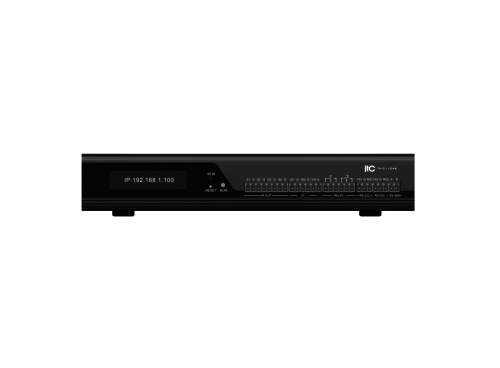
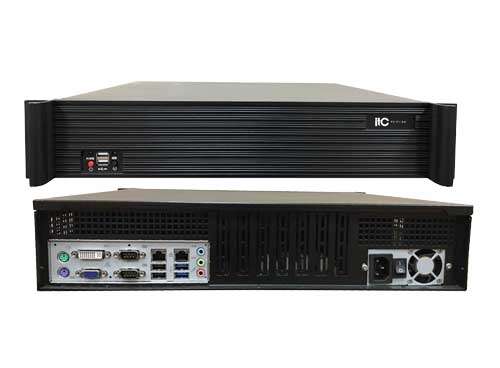
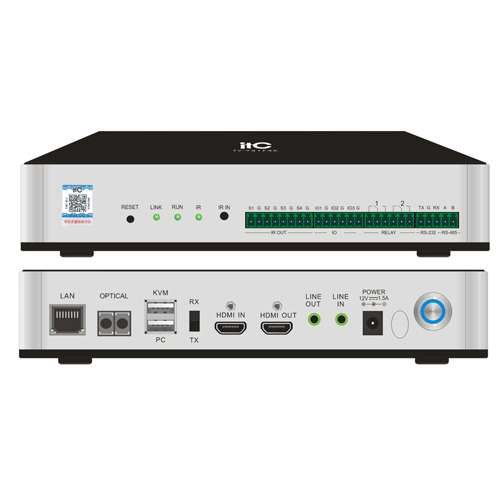
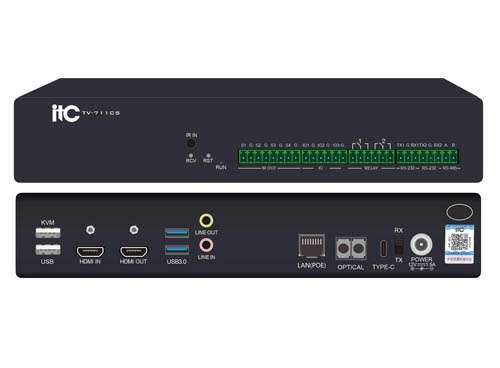
It is an integrated input and output terminal of a visual management platform. It integrates powerful system functions such as visual management, KVM collaboration, splicing, network transmission, matrix, central control and fusion. It adopts a completely distributed structure design and supports unlimited unit extension; any unit failure will not affect the operation of the entire system, featuring high reliability. It is designed with a redundancy and backup design, bringing strong stability; it supports KVM cross-screen roaming, and mouse control with ultra-low delay. With built-in self-developed video splicing synchronization algorithm, it can be directly connected to the LED video wall. It is characterized by desktop design (optional rack accessories) and elegant appearance.
* Input and output integrated design, can be configured as input terminal, output terminal, KVM input terminal or KVM output terminal according to needs.
*Integrated input and output design allows for configuration as an input terminal, output terminal, KVM input terminal, or KVM output terminal based on requirements.
*As an input node, it supports 4K@60fps, 4K@30fps, 1920×1080P@60fps, and 1920×1080P@30fps HD video signal input, with backward compatibility. It also supports simultaneous multi-stream transmission, with 4K input compatible with both 4K and 2K output terminals.
*Supports real-time preview of input signals via the client, ensuring full control over signal status.
*Logo: When used as an input node, you can add an image to the input source as the logo without adding any external devices. You can set the logo to display in the top left or bottom left corner, or at custom X and Y coordinates. You can upload new images or use existing ones.
*Video Wall Subtitles: When used as an output node, you can display subtitles (such as welcome messages) on the video wall without adding any external devices. You can set the font type, alignment, font size, font color, background color, transparency, scrolling speed, font spacing, centering, and display position.
*Input Box Subtitles: When used as an input node, you can display subtitles on the input source without adding any external devices. You can set the font type, font size, font color, background color, transparency, and display position.
*Local HD Background: When used as an output node, you can display the background image for the video wall without adding any external devices. You can load a custom local image and enable or disable the background image function in the software. * Features a 3.5mm analog audio port and an HDMI digital audio port, capable of transmitting raw, uncompressed PCM audio. It supports AAC and OPUS audio codecs.
* Supports KVM functionality, enabling graphical (non-text) screen capture, takeover, and push to any monitor or large screen. KVM cross-screen roaming and virtual mouse control optimize the KVM user experience, supporting cross-platform operation across Windows, Linux, and Mac platforms.
* KVM supports visual management of the OSD menu, allowing users to adjust the number of preview videos per page to meet their needs, up to eight per page. KVM takeover includes prompts and confirmations.
* Supports KVM role permission management, allowing users to control KVM signal management permissions through server permission management.
* Supports fingerprint scanners for KVM fingerprint login and facial recognition login with USB cameras, establishing fast, reliable, and secure access channels.
* Embedded with proprietary video splicing and synchronization algorithms, it eliminates the need for a splicing processor and can directly connect to LED, LCD, DLP, and other splicing screens, ensuring tear-free and synchronized video. * Built-in input synchronization supports simultaneous capture and encoding of an 8K signal source on four input nodes, and simultaneous decoding and display on four output nodes. The entire 8K signal is clear and smooth, without tearing, ensuring seamless transmission of 8K signals.
* Equipped with central control functionality, it features one independent RS-485 port, two RS-232 ports, two low-power relay ports, three I/O ports, and four infrared output ports, supporting custom programming.
* Built-in infrared learning module learns infrared codes for infrared remote control devices, including camera remote controls.
* The control interface supports bidirectional data transmission and supports connecting to sensor devices to display environmental data and other information on the tablet.
* Features a 2.23-inch OLED display that displays the terminal's IP address and operating status in real time.
* Features a desktop design with an optional cabinet-style cooling rack for unified power management.
* Utilizes domestically produced chips and a domestically controlled embedded Linux system, supporting 24/7 continuous operation.
* Supports rapid online batch upgrades via the server. *Supports automatic recovery from power outages, allowing the device to automatically return to its pre-outage state.
*Supports one-touch dynamic IP reset.
*Supports dual DC12V/POE power supply modes, offering low power consumption up to 10W, and features a power adapter with an anti-dropout device.
*Supports dual-link backup for optical fiber and Ethernet ports.
*Supports a packet loss recovery mechanism, ensuring smooth audio and video with no lag or pixelation even at 20% packet loss.
*Supports offline hold, allowing the device to maintain normal display and output even when disconnected from the server, preventing freezing or black screens.
*Supports USB transparent transmission, eliminating the need for additional equipment or a separate network. Simply connect a single Ethernet cable or bidirectional fiber optic cable to transmit media, signaling, and USB transparent data. This supports USB devices such as USB flash drives, USB cameras, USB keys, and USB HIDs.
*Supports SIP protocol, with built-in agent video intercom functionality. It supports connecting external USB cameras, USB headsets, and standard SIP devices for video intercom. * Supports national encryption algorithms SM2, SM3, and SM4 for encrypted signaling and media stream transmission, ensuring data security and controllability.
* Built-in AI gesture recognition, which recognizes different gestures and converts them into control commands for zooming, dragging, and full-screening signal sources.
* Supports simultaneous control of four 4K60 or 16 1080P60 video signals, each with KVM control. With one-click full-screen zooming and restoring of any source, any currently controlled video signal can be pushed to any window on any video wall.
*When used as an output node, it supports setting an audio equalizer, which can be enabled or disabled, as well as dynamic compression. It has 18 built-in common equalizer scenes that can be switched with one click or fully customized. The gain can be controlled individually for different frequency bands such as 60Hz, 170Hz, 310Hz, 600Hz, 1KHz, 3KHz, 6KHz, 12KHz, 14KHz, and 16KHz, with a range of -20dB to 20dB.
*Supports signal cropping, allowing you to set cropping coordinates, width, and height to crop the input signal. *Supports signal source annotation. When used as an input node, you can annotate input signals via the control tablet, PC, KVM station, or web client. When used as a KVM output node, you can annotate signals from connected input boxes. Annotations support freehand lines, straight lines, arrows, squares, circles, triangles, and other annotation shapes. You can set the line thickness and color, undo and redo annotations, and use the eraser to delete or remove all annotations.
*Supports KVM instant messaging, allowing you to communicate with one or all users via text or screenshots. Images can be zoomed in and out, and can be dragged and dropped after zooming.
*Supports the addition of a time display control, allowing you to configure the time display's coordinate position, font size, font color, background color, transparency, font spacing, font type, and display style.
*Supports the addition of a temperature display control, allowing you to configure the temperature display's coordinate position, font size, font color, background color, transparency, font spacing, font type, temperature prefix, and temperature suffix. *Supports the addition of a humidity display control, allowing you to configure the humidity display's coordinate position, font size, font color, background color, transparency, font spacing, font type, humidity prefix, humidity suffix, and more.
*Supports the addition of a real-time people counting control, allowing you to configure the display's coordinate position, font size, font color, background color, transparency, font spacing, font type, statistics prefix, statistics suffix, and more.
*Supports the KVM account tracking function, automatically opening a window to display the last used signal source after logging into any KVM video wall account.
*Supports AI target recognition algorithms, enabling video structured analysis capabilities such as pedestrian attribute recognition, crowd counting, area crowd counting, area over-capacity detection, face capture, face recognition, pedestrian capture, vehicle capture, high-frequency stranger detection, low-frequency person detection, and more.
*Supports AI perimeter protection algorithms, enabling video structured analysis capabilities such as area intrusion detection, electric bicycle entry into elevator detection, and non-motor vehicle illegal parking detection. *Supports AI behavioral recognition algorithms, enabling video structured analysis capabilities such as identification of people leaving their posts, not wearing masks, making phone calls, smoking, falling, fighting, wandering, using mobile phones, holding knives, sleeping, climbing, climbing over walls, and crowds.
*Supports AI work safety recognition algorithms, enabling video structured analysis capabilities such as identification of people not wearing work clothes, shorts and short sleeves, not wearing helmets, and not wearing reflective clothing.
*Supports AI environmental safety recognition algorithms, enabling video structured analysis capabilities such as identification of smoke, open flames, overflowing trash cans, exposed garbage, and objects thrown from high places.
*Supports AI intelligent traffic recognition algorithms, enabling video structured analysis capabilities such as identification of illegally parked vehicles, vehicle flow statistics, regional vehicle statistics, vehicle congestion detection, overparked vehicles, license plate obstruction detection, concrete mixer trucks, dump trucks, uncovered dump trucks, safety ropes, and exposed soil. *Supports AI-powered smart water management recognition algorithms, enabling video structured analysis functions such as person-overboard identification, regional vessel counts, vessel traffic statistics, and vessel intrusion detection.
*Latency between the signal source and the entire signal process, including input node acquisition, H.265 encoding, network transmission, H.265 decoding, and display, is reduced to 16.7ms.
*Supports OCR text recognition, capturing a computer screen captured by the input box as an image for AI analysis. The extracted text can then be extracted and transferred to another computer via the KVM output box. The extracted text can then be pasted into a file.
*The terminal supports a decentralized serverless architecture deployment, with each node independent and non-interfering. A failure in any node does not affect system operation, improving system stability and reliability. *Supports setting of common layouts such as 1P, 4P, 9P, 1+4P, 1+5P, 1+7P, 2+8P, 1+12P, and 16P. You can also customize the number of rows and columns in the layout, reuse the original layout of the video wall output box, and enable auto-fill layout mode.
*Supports video wall recording, allowing you to copy the video wall layout for recording, and supports 16-split screen recording.
*Supports RTSP, ONVIF, and GB28181 protocols, allowing direct connection and pulling of surveillance signals.
|
Processing capability |
When used as an input node, it supports 4K@60fps acquisition, 4K@60fps encoding, and is backward compatible. When used as an output node, it supports 4K@60fps decoding, 4K@60fps output display, and is backward compatible, supporting 4-channel 4K@60 or 16-channel 1920×1080@60fps decoding; supporting H.264/H.265 video codec |
|
Processor |
Domestic processor (8 cores), built-in 6 TOPS computing power, 8GB RAM, 32GB eMMC storage |
|
Codec capability |
Support PCM audio lossless transmission, AAC codec, OPUS codec |
|
Video port |
3×HDMI IN、2×HDMI OUT、1×DP OUT |
|
Audio port |
2*3.5mm stereo input, 2*3.5mm stereo output, input sensitivity: 775mV |
|
USB port |
2×USB2.0 (KVM interface), 2×USB3.0(Support audio and video input), 1×Type-C |
|
Network port |
1×RJ45,10/100/1000Base-T, support POE |
|
OPTICAL port |
1×SFP |
|
Serial port |
1×RS-485、2×RS-232 |
|
Infrared port |
1×IR、4×IR OUT |
|
I/O port |
3*I/O port |
|
Weak relay port |
2*RELAY port |
|
Reset button |
1*pinhole RESET button |
|
Mode switch |
1*input and output mode switch |
|
Display screen |
2.23-inch OLED display with 128*32 pixels |
|
Power supply |
DC 12V/POE |
|
Max power consumption |
10W |
|
Ambient temperature |
-10°C~45°C (working state); -15°C~45°C (non-working state) |
|
Ambient humidity |
5%~90% (working state), no condensation |
|
Weight |
About 1.0 kg |
|
Dimension (L*W*H) |
240×117×41.8mm |
Please leave a message if necessary, we will contact you as soon as possible!